In an age shaped by rapid AI adoption, deepfakes, and constant misinformation, trust has become mission-critical in business.
Three forces are converging:
-
artificial intelligence,
-
trust
-
digital transformation
Many CIOs are finding that the challenge is no longer innovation but the architecture to sustain it effectively. The architectural foundations needed to sustain innovation at scale are missing.
Organisations that succeed in this next phase will not be those deploying the most AI tools. They will be the ones who can manage complexity and treat trust as a conscious design element in their digital environments.
Legacy Complexity, Not Legacy Technology
When digital initiatives struggle, legacy technology is often blamed. In reality, the age of systems is not the key problem.
The bigger issue is accumulated complexity. Years of transformation have created fragmented data, inconsistent processes, and integration layers built for short-term delivery rather than long-term resilience. This leads to transformation fatigue. Organisations are not short of platforms or tools; they are short of coherence.
This challenge becomes especially visible in AI programmes. Many stall not because the technology is immature, but because data is fragmented, integrations are brittle, and accountability is unclear.
Today, innovation depends less on delivery velocity and more on how well existing systems connect. Integration has become the real frontier of innovation.
AI is a Lens not a Panacea
A common assumption is that AI will simplify complexity. In practice, it does the opposite.
AI magnifies what already exists. Strong data pipelines become more valuable. Poor data quality leads to incorrect outcomes at scale. Well-structured integrations support automation. Fragile ones create instability.
This is why the architecture, rather than the algorithm, is the real differentiator in the age of AI. AI does not fix foundational problems. It exposes them.
Trust Must Be Designed Into the System
As organisations adopt AI, automation, and more connected services, their risk surface increases. Cybersecurity, compliance, data governance, third-party dependencies, and operational resilience all become harder to manage.
Trust has to be designed into the system from the start, not bolted on as an overlay at the end.
In technology environments, trust is closely linked to risk management. Strong governance, predictable system behaviour, and clear accountability build confidence. Weak controls undermine it.
Architectures that prioritise interoperability, transparency, and embedded governance allow organisations to scale innovation without increasing exposure. They also reduce the long-standing tension between speed and control.
From Silos to Systems
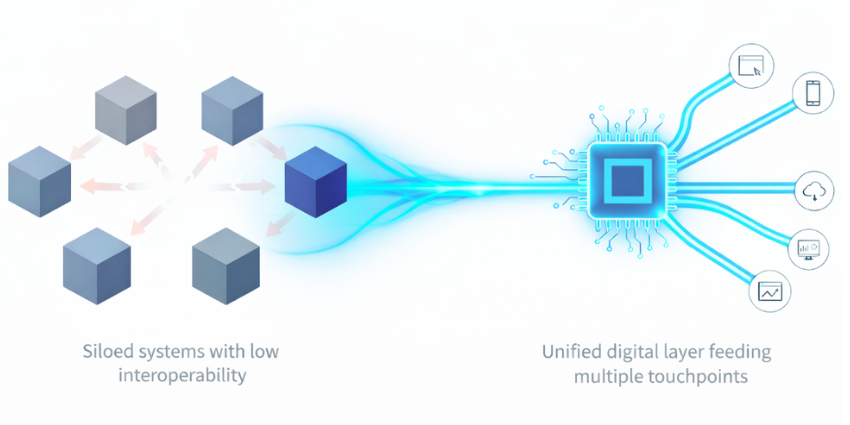
Users expect consistent experiences across channels, whether they are customers, employees, or partners. They do not see internal structures. They experience one organisation.
Delivering this consistency requires a unified digital foundation that connects experience, data, and governance into a single system. This is what enables Total Experience. When systems are connected, behaviour becomes more predictable, and trust becomes easier to maintain.
Total Experience is not a design trend. It is an architectural requirement.
Priorities for 2026
The CIO challenge is no longer choosing between innovation and control. It is designing architectures that support both.
Interoperability must come before intelligence. Resilience must matter as much as speed. Trust and governance need to be treated as strategic assets rather than overhead.
Trust cannot be automated. It has to be architected.
Managing Complexity with Liferay
As CIOs look to operationalise these principles, platforms like Liferay are increasingly being used to bring coherence to complex digital environments. By acting as a unifying layer across experiences, integrations, and governance, Liferay helps organisations reduce fragmentation, connect existing systems, and design trust directly into their digital architecture, enabling innovation to scale without increasing risk.
Want to explore this further? Join our Solution Showcase - "The Architecture of Trust: Managing Complexity in the Age of AI on 21 April at 10:00 BST, where Mike MacAuley will unpack why AI programmes stall, how to design trust into your architecture, and what CIOs need to prioritise to scale innovation without increasing risk. Register here.